
Mango Lassi
Thick yogurt blended with sweet Alphonso mangoes — cool, creamy and the perfect Indian...
Betel nut with paan leaf — the sacred Assamese after-meal ritual and social bond

About Tamul Paan: Tamul (areca nut) wrapped in paan (betel leaf) is the most sacred social custom of Assamese culture. Offering tamul to a guest is the highest form of respect — equivalent to offering tea or wine in other cultures. It is the post-meal digestive, the wedding gift, the funeral offering, and the first thing offered when a guest enters an Assamese home. Important note: this is a cultural and ceremonial preparation, not food in the nutritional sense.
IMPORTANT HEALTH WARNING: Areca nut consumption is associated with significant health risks including oral cancer when used regularly over time. The World Health Organization classifies areca nut as a Group 1 carcinogen. Tamul Paan is best understood as a ceremonial offering rather than a daily habit. If you choose to prepare it, treat it as you would alcohol — for occasional ceremonial use only.
Understand the components: There are three components — fresh tamul (areca nut), fresh paan (betel leaf), and a tiny smear of choon (slaked lime, calcium hydroxide). Each plays a role: the areca nut is the centre, the leaf is the wrapping, the lime activates the chemistry between them.
Source fresh areca nuts: Use 4 fresh, young areca nuts (tamul). Fresh nuts are firm, with a slightly green-cream colour and a wet, slightly rubbery texture inside. Dried split areca pieces (often sold in Indian groceries) work too but are considered second-best by Assamese tradition.
Choose good betel leaves: Use 4 fresh betel leaves (paan). They should be heart-shaped, deep green, glossy and unblemished, about 10-12cm wide. The smell is distinctive — sharply peppery and slightly cooling. Wilted, yellowed or torn leaves should be avoided.
Wash the leaves gently: Rinse the betel leaves under cold running water with very gentle hand-rubbing — they tear easily if scrubbed. Pat dry between two clean kitchen towels. Damp leaves do not fold cleanly.
Snip the stem: With a small sharp knife, trim off any thick stem at the bottom of each leaf. The leaves are easier to fold without the woody stem.
Source food-grade slaked lime: Use a small container of choon (slaked lime, often labelled chuna or kali in Indian groceries). It is sold as a thick white paste. Use only food-grade slaked lime sold for paan; never use construction or industrial lime, which contains harmful additives.
Measure the lime carefully: You need only the tiniest smear — about the size of a small lentil — per leaf. Excess lime burns the mouth.
Prepare the areca nut: Take a fresh areca nut. Use a heavy knife or specialised tamul-cutter (sarota — a metal scissor-style tool used in Assamese households). Cut the nut in half lengthwise, then quarter each half. You should have 4 small pieces from each whole nut.
Lay the leaf shiny-side down: Place a betel leaf on a clean plate or tray with the shiny darker side facing down and the matte paler side facing up. The matte side is what touches the lime.
Apply a tiny smear of lime: Use the back of a small spoon or a clean fingertip to smear about a lentil-sized amount of slaked lime in the centre of the leaf. Spread it into a small circle about 2cm wide. The smear should be thin enough that you can see the leaf through it.
Place the areca pieces: Place 4 quartered areca nut pieces in the centre of the leaf, on top of the lime smear.
Fold into a cone packet: Fold the bottom half of the leaf up over the filling. Then fold the right side toward the centre, then the left side over that. The packet should be roughly triangular or pyramid-shaped, fully enclosing the contents. Some Assamese fold it into a tight cone shape, like a samosa wrap.
Tuck the top: Fold the remaining top of the leaf down and tuck the tip into the natural gap of the folded packet. The packet should hold its shape without any pin or thread — the betel leaf is naturally slightly tacky and self-seals.
Secure with a clove (optional): Some Assamese tradition uses a single clove pushed through the packet to hold it together — this is decorative and adds a tiny aromatic note.
Present with both hands: This is the most important step. Tamul Paan must be offered with both hands, with a slight bow of the head. The recipient takes it with both hands too. Offering with one hand is considered disrespectful in Assamese culture.
The ceremonial moment: When a guest enters your home, this is the welcome ritual. When a meal ends, this is the digestive offering. At weddings, the bride and groom's families exchange tamul paan as part of the formal customs.
The consumption: The eater pops the entire packet into their mouth and chews slowly. The mixture releases a warm, slightly sweet-bitter taste. Within minutes, the lime-areca chemistry produces the distinctive red-orange colour that stains the mouth — historically considered a sign of celebration in Assamese culture.
Final cultural note: While this preparation has deep ceremonial value, please remember the health warning above. Honoured ceremonial offerings need not become daily habits. Many modern Assamese serve tamul paan only at weddings and special occasions, which preserves the cultural meaning while respecting health considerations.
Thick yogurt blended with sweet Alphonso mangoes — cool, creamy and the perfect Indian...
 ⭐ Featured
Spiced black tea with ginger, cardamom and cinnamon — India's universal warm embrace in a cup.
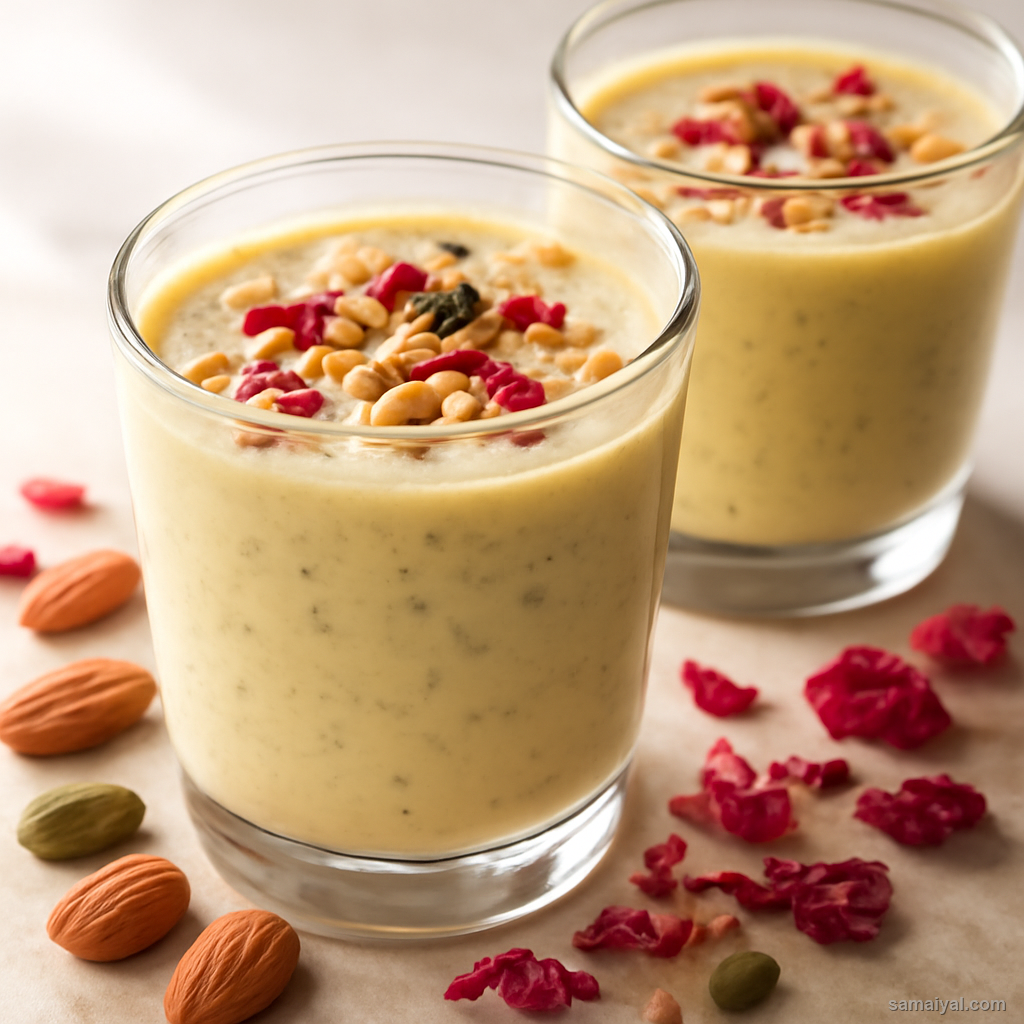
Chilled almond-spice-rose milk drink traditionally made for Holi — refreshing,...

Indian spiced lemonade with roasted cumin and black salt — light, tangy and the best...
Comments & Tips
Be the first to share your experience with this recipe!
Leave a Comment